
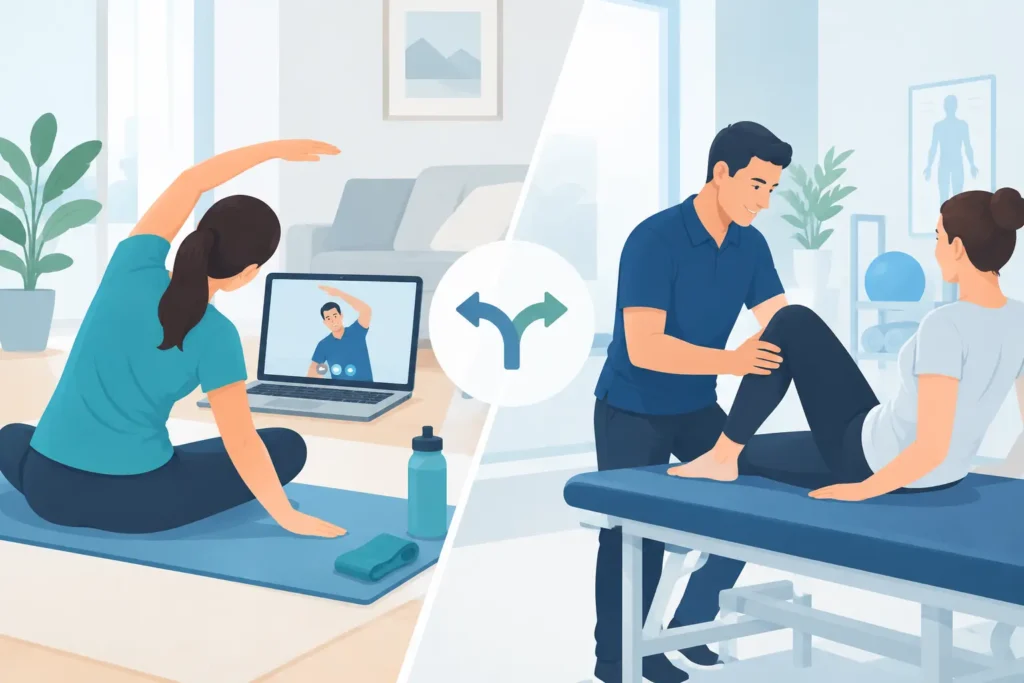
Back pain that flares up between workdays, a sprain that slows you down, or a shoulder injury that limits your movements shouldn’t force you to choose a treatment at random. The question of whether to opt for telerehabilitation or an in-person clinic visit often comes up when scheduling an appointment. The right answer depends less on whether you prefer a screen or going out than on your condition, your goals, and what your healthcare professional needs to assess you properly.
Tele-rehabilitation allows patients to consult with a professional remotely via videoconference. An in-clinic consultation takes place in person and provides access to a more comprehensive physical evaluation, as well as certain manual therapies or specialized equipment. Both approaches can be effective; they simply do not always address the same needs.
Telerehabilitation or In-Person Clinic Visits: What’s Really Changing
The first appointment is designed to help us understand your problem, your symptoms, your limitations, and your life circumstances. During telerehabilitation, the professional will ask you specific questions, observe your movements, and guide you through certain safe functional tests. They can observe how you get up from a chair, climb a step, carry an object, or perform the movements that trigger your pain.
This observation in your usual environment is particularly helpful. Someone with neck pain while sitting at a computer can show their workstation. A parent with a sensitive back can demonstrate how they lift their child. A runner can describe their training routine and show their shoes or where they exercise. This makes the recommendations very specific.
In a clinical setting, however, an evaluation allows for a more in-depth assessment when palpation, precise measurement of certain ranges of motion, strength tests, or tissue examination are necessary. The professional can also assess your balance, gait, and responses to various movements in a controlled environment. Depending on your treatment plan, manual therapy, electrotherapy, or access to exercise equipment may also be recommended.
The choice, therefore, is not a matter of choosing between two types of care. It is a matter of determining which format allows for a safe evaluation and effective follow-up for your situation.
When Telerehabilitation Is a Good Option
Telerehabilitation is often appropriate for pain and functional limitations where education, activity modification, and progressive exercises play a central role. This is particularly true for various types of back, neck, shoulder, or knee pain, especially when symptoms are stable and there are no concerning signs.
It may also be appropriate if you have already had an in-person evaluation and are continuing your rehabilitation program. Remote follow-up makes it easier to make adjustments: progressing through exercises, correcting technique, gradually returning to work, preparing for sports activities, or managing symptoms between appointments.
For many patients, the main advantage is convenience. You avoid travel time, parking hassles, and extended absences from work. This option can be invaluable if you live far from a clinic, if your mobility is temporarily limited, or if your family schedule leaves little wiggle room.
The quality of a virtual session also depends on your participation. You’ll need a stable internet connection, a device with a camera, a space where you can move around safely, and, ideally, a few minutes without interruptions. You don’t need sophisticated equipment: a chair, a wall, a towel, or everyday objects are often enough to get started.
What Your Professional Can Do Remotely
A virtual consultation is more than just sending you a list of exercises. The professional analyzes your situation, explains the possible causes of your pain, helps you set realistic goals, and tailors the recommendations to your progress. They can observe your movements from multiple angles, correct your form, and adjust the difficulty level as your sessions progress.
Tele-rehabilitation is also helpful for increasing your independence. Understanding which movements are safe, how to pace yourself, and what to adjust when you experience a flare-up of pain gives you practical guidelines to follow between appointments.
In what situations should a clinical approach be prioritized?
An in-person consultation is often preferable following a recent injury accompanied by severe pain, swelling, significant loss of strength, or difficulty using a limb normally. It is also recommended when a more detailed examination is needed to better guide treatment.
For example, after a fall, a severe sprain, surgery, a workplace accident, or a traffic accident, an in-clinic evaluation can provide a more comprehensive assessment. Your healthcare professional can track your progress, administer specific tests, and coordinate care with other team members when appropriate.
The clinic may also be the best choice if you need close supervision to learn exercises, regain confidence in your movements, or use rehabilitation equipment. Some people make more progress when they have direct contact and physical cues during their movements. This is a valid preference, just as the convenience of virtual follow-up is.
Signs That Require Prompt Evaluation
If your pain is accompanied by sudden weakness, significant loss of sensation, an inability to bear weight, visible deformity, fever, chest pain, or unusual symptoms following an injury, do not simply choose the most convenient option. An urgent medical evaluation may be necessary.
Similarly, pain that worsens rapidly, constantly wakes you up at night, or is accompanied by changes in bladder or bowel control requires prompt medical attention. A healthcare professional can help refer you to the appropriate level of care, but these situations should not be managed solely through a routine virtual consultation.
The hybrid approach: an often-effective solution
You don’t have to stick to the same format from start to finish. A hybrid approach can combine the benefits of both methods. You could start with an in-person evaluation at the clinic, then conduct some follow-ups via telerehabilitation once your treatment plan is well established. Conversely, an initial virtual consultation can help clarify your needs and schedule an in-person evaluation at the right time.
This flexibility is particularly beneficial for working professionals, parents, and people who are following a return-to-sport program. An in-person clinic visit can help reassess your condition or advance certain exercises, while virtual follow-ups help you stay consistent during busier weeks.
At Physio Multiservices, our professionals can also assess whether you might benefit from additional services. Depending on your situation, working with a kinesiologist, an occupational therapist, a sports therapist, or another professional can support your return to activities. The goal remains the same: to guide you toward care that is tailored to your condition and your goals.
How to Choose the Right Format for Your Meeting
Start by asking yourself three simple questions. Does your condition require a detailed physical exam or an in-person procedure? Can you move safely at home in front of a camera? And which factor is most likely to interfere with your follow-up care: travel or the lack of direct supervision?
If you’re unsure, describe your symptoms when you make your appointment. Mention how long you’ve had the pain, what makes it worse, what relieves it, any treatments you’ve already received, and any triggering events, such as a fall or a sudden, awkward movement. This information helps us recommend the most appropriate service and format.
Also, be sure to consider the administrative requirements. These may vary depending on your private insurer, your CNESST or SAAQ case, and the type of professional you’re seeing. It’s best to check your coverage before your appointment rather than assuming it’s the same for virtual and in-person care.
The best choice is one that allows you to receive a thorough evaluation, follow recommendations in a realistic way, and respond quickly if your condition changes. Whether it begins in front of a camera or in a treatment room, effective rehabilitation should help you perform tasks more easily, resume activities with confidence, and lead a daily life less limited by pain.